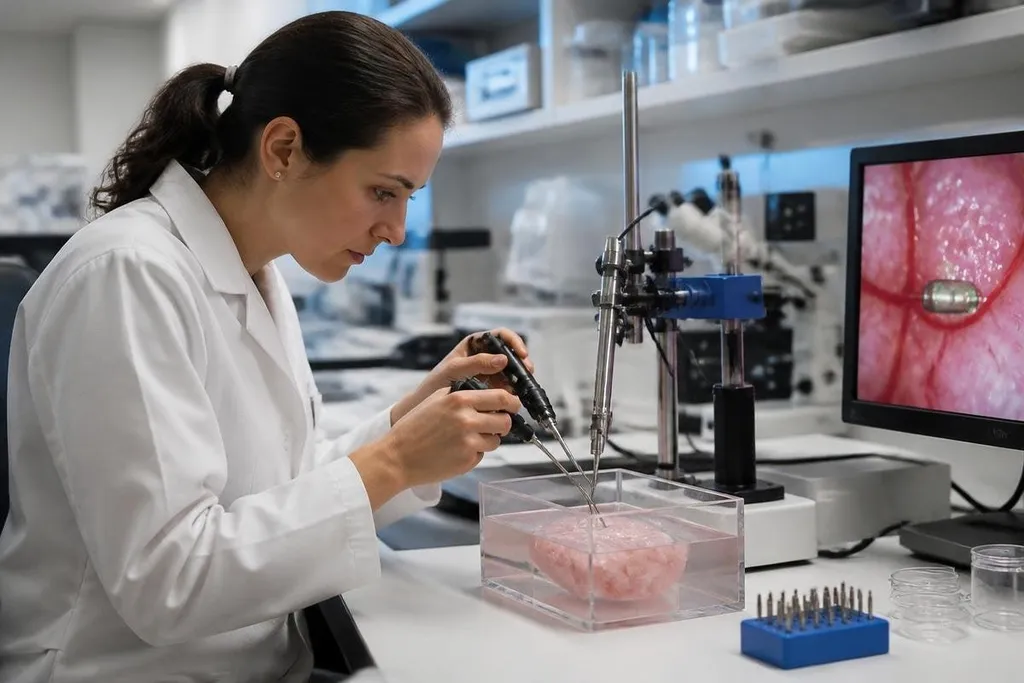
A robot small enough to move through the body could reach places a larger surgical tool cannot. The difficult part is making that motion safe when the robot is hard to see, hard to retrieve, and controlled through soft tissue.
- Small size could help tools reach narrow spaces.
- Imaging and control must work together during the procedure.
- Retrieval, power, and failure handling still need clear answers.
What a tiny surgical robot would need to do
A small surgical robot would need more than a miniature motor. It would need to move, stop, and hold position while forces around it change. Blood flow, breathing, tissue movement, and contact with an instrument could all affect its path.
The machine might carry a camera, a gripper, a cutting tool, or a mechanism that releases medicine. Each added part takes up space and adds another way for the system to fail. A smaller body leaves less room for batteries, sensors, wiring, and cooling.
Control would also look different from operating a standard robotic arm. A surgeon could guide a tool from outside the body, while the robot responds to commands inside it.
That link must show the robot’s position and contact with tissue clearly enough for the surgeon to act before a small error becomes a serious problem.
Seeing the robot is as hard as moving it
A surgeon cannot rely on direct sight if the robot works inside a body cavity or vessel. The system would need imaging, position data, or both. That information must arrive quickly and match the robot’s real location.
A camera may show nearby tissue but not the forces acting on the robot. An external scanner may show position but offer less detail about a tool touching tissue. The design therefore depends on the operation, the body area, and the task the robot must complete.
That choice makes the test record matter: medical robotics reporting can connect a surgical robot’s sensor setup, test task, and measured result. Those details show whether a claim reaches beyond a controlled demonstration and into the body, where motion and contact can change the robot’s behavior.
A system that moves well in a model is not ready for surgery. Engineers would need to show how it behaves with body motion, limited visibility, signal loss, and an operator who must make quick decisions.
Power and recovery set the limits
A tiny robot needs a way to receive power or carry enough energy for its task. A battery adds mass and takes up space. A cable can carry power and data, but it may limit movement or create a path for unwanted force.
Some designs could receive commands or energy from outside the body. That approach may reduce the parts inside the patient, yet it adds demands on tracking and control. The safe choice depends on the robot’s location and how long it must work.
Recovery matters as much as the main task. If the robot loses power, stops responding, or breaks apart, the medical team needs a known way to find and remove it. A surgical device cannot depend on a reset button that nobody can reach.
The first useful tasks will be narrow
Tiny robots are more likely to begin with one controlled task than a full operation. A narrow job makes it easier to set limits, test motion, and check what happens when the system leaves its planned path.
Possible tasks include holding a camera in a confined space, placing a small tool, moving a sample, or releasing material at a chosen location. Each task still needs evidence from models, laboratory tests, and supervised clinical work before wider use.
The opposing view has weight: smaller machines could reduce access points and reach difficult areas. Size alone doesn't solve control, visibility, or removal, so a larger tool may remain the safer choice for many operations.
I’d judge a tiny surgical robot by its recovery plan before its smallest measured dimension.
A practical test for any new claim
When a company or research team presents a tiny surgical robot, check these points before treating the demonstration as a medical system:
- Task: What exact action did the robot complete?
- Setting: Was the test done in a body model, animal study, or clinical procedure?
- Control: Who guided the robot, and what information did they see?
- Failure: What happens after lost power, bad data, or a stuck mechanism?
- Retrieval: How does the medical team remove the robot?
- Evidence: Which results were measured, and which claims remain unproven?
The useful question is not whether a robot can be made tiny. It is whether doctors can see, control, and recover it through the full procedure. Until those three parts work together, miniature surgery remains a design target rather than a routine tool.